The browser you are using is not supported. Please consider using a modern browser.
How it Started
In 1858, Margaret Fuller, a widow, brought her six children from Ohio and purchased 43 acres and a tract called Sophie’s Garden Regulated, adjacent to Taylor Avenue and Belair Road.* The Lassahn family, as well as other early families in Fullerton, played significant roles in the business and community development of the area. The first post office and general store opened in 1885. Fullerton School started in 1886 in a one room log house. In 1890, it was replaced with a frame school house built on land purchased from the Lassahn family.
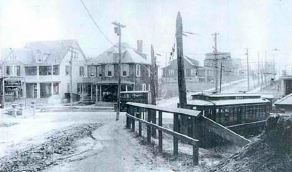
Overlea was rural, made up mainly of farmland. Real estate men recognized that the high-lying farmland would make excellent home sites and persuaded the United Railways to extend the Belair Road carline. Belair Road was unpaved in 1902, and the single track carline only ran four times a day, ending at Kenwood Avenue.
The introduction of the trolley service created interest in the location and cottages started springing up. Lange’s Farm was the first name for the area, but the name was changed to Overlea which means “over the meadow.” Apparently from the elevation of the land along the 6800 and 6900 blocks of Belair Road some residents said they could see the bay from their attic windows on a clear day.
In 1910 Cherry Heights was the first housing development in the county intended for African American homeowners. Also that year, Overlea saw its first drug store open and the Overlea Methodist Church was founded when a group of forty people met at the mansion of Mr. and Mrs. James T. Everett to establish a Sunday School in Overlea. In 1910, a grocery store/Town Hall opened on the northwest corner of Belair Road and Overlea Avenue, which is currently the site of the Maryland Natural History Society.
In 1913, the Women’s Suffrage Movement stopped in Overlea during the march from New York to Washington, DC. They held a meeting at the Town Hall, but most residents were not sympathetic to their cause. The suffragettes stayed in the homes of local residents and the meeting won some supporters. Also that year, St. Michael the Archangel Catholic Church held its first service in the Town Hall.
In 1919, part of Overlea was annexed by the city. The bi-section of Overlea with the city-county line made it a community under two flags, governmentally speaking. The resulting city-county line bisects 29 parcels of land in the neighborhood, sometimes in curious ways.
The Overlea Improvement League worked to have Belair Road widened to eighty feet with streetcar tracks in the middle and to have a sewage system installed. By
1926, Overlea had all the city conveniences- electricity, gas and water.
* Excerpts from “A (very) Concise History of Overlea” by John Stewart. John grew up on Beech Avenue and passed in 2017.
Read more on the History page.
-
Doris Poling
 Vice President